I've done a lot of card sleeving over the years. Starting with nasty thin sleeves that didn't always fit nicely, progressing in recent years to fancy Gamegenic sleeves, even paying extra for their luxurious matte ones. Not every game I bought got sleeved, but expensive games or games likely to go out of print, any game for which it would be expensive or difficult to replace the cards was seriously considered for sleeving.
But more recently I have begun to resent the inconveniences that come with sleeving: doubling the height of draw piles; low friction making it easy for card piles to slip sideways scattering cards abroad; storage problems fitting the sleeved cards into a box designed for unsleeved; the optical glare, making it difficult to read cards (even those matte ones) in certain lights. And a growing guilt about bringing more plastic into the world.
Also – why do I want my games to last forever?
I'm 67; there are many more gaming years behind me than there are yet to come. How many more times are most games in my collection likely to get played? And why do they need to stay pristine in any case? I bought my copy of 1830 in the late 1980's. It's had a lot of play over the years, and is by now fairly well worn. But the game's shabby state doesn't really matter – no pieces are missing, it's perfectly playable. And the shabbiness is a sign that this game is much loved. It has a history with me, and I value it the more for that. If offered a swap for a brand new copy, I would say no.
So I have begun to unsleeve my games. There are a few exceptions. For example the Action cards in Arcs, which get a hammering many times more severe than the other cards in the game, are staying sleeved. But I'm rediscovering the tactile pleasure of using unsleeved cards, of low-glare text and low-rise draw piles, of the springy feel of good quality cards splayed in my hand. And in the gaming years left to me, I hope I will remember to prioritize play over preservation.
Monday, May 18, 2026
Thursday, May 07, 2026
Do I really want to win?
When I was younger – in my 30's or 40's say – I had a real heartfelt need to win, at least occasionally. Whereas nowadays – in my late 60's – I tell people that I no longer care whether I win or lose – it's the experience of playing that motivates me.
That's what I tell people.
But at my last HandyCon (which I visited just for the Sunday) I played 5 games and lost every single one of them, in most cases not just lost but lost very badly. And I must confess that by the end of the day I was feeling a bit gloomy. Just one little win would have lifted my spirits. So perhaps I do care.
There is a tacit agreement we make when we sit down to play a multi-player boardgame – that we will all try to win. It can really mess up the experience if one player decides to act randomly just for the hell of it. I had an unpleasant experience along these lines – a few decades ago now but it still sticks in my mind. 5 or 6 of us had sat down to play Civilization, two of whom had never played the game before. As you know, playing Civilization is a substantial commitment – you're looking at 9 or 10 hours to complete it. Anyway, one of our number, let's call him "D", pretty quickly decided he did not like this game, and decided to pass the time beating up on his neighbour "S" (the other newbie), even though he knew this would ruin not only his chances of a win, but S's chances also. Well, the atmosphere around the table rapidly became pretty sour. D's random disruption spoiled the day for all of us. And as for S, we never saw him again.
Of course you can want to win too much as well as too little. I think this often lies behind behaviours that we commonly label Analysis Paralysis (AP). You want to win so intensely that you are prepared to spend as much time as it takes to optimize your turn, regardless of the boredom and frustration this inflicts on the other players. I experienced this just the other day at my local club – the culprit's turns were taking longer then the other three of us combined. This sort of thing is just as much a violation of the social contract as not tryig to win at all, and in my experience it is more common. I will certainly go out of my way to avoid this opponent in future.
That's what I tell people.
But at my last HandyCon (which I visited just for the Sunday) I played 5 games and lost every single one of them, in most cases not just lost but lost very badly. And I must confess that by the end of the day I was feeling a bit gloomy. Just one little win would have lifted my spirits. So perhaps I do care.
There is a tacit agreement we make when we sit down to play a multi-player boardgame – that we will all try to win. It can really mess up the experience if one player decides to act randomly just for the hell of it. I had an unpleasant experience along these lines – a few decades ago now but it still sticks in my mind. 5 or 6 of us had sat down to play Civilization, two of whom had never played the game before. As you know, playing Civilization is a substantial commitment – you're looking at 9 or 10 hours to complete it. Anyway, one of our number, let's call him "D", pretty quickly decided he did not like this game, and decided to pass the time beating up on his neighbour "S" (the other newbie), even though he knew this would ruin not only his chances of a win, but S's chances also. Well, the atmosphere around the table rapidly became pretty sour. D's random disruption spoiled the day for all of us. And as for S, we never saw him again.
Of course you can want to win too much as well as too little. I think this often lies behind behaviours that we commonly label Analysis Paralysis (AP). You want to win so intensely that you are prepared to spend as much time as it takes to optimize your turn, regardless of the boredom and frustration this inflicts on the other players. I experienced this just the other day at my local club – the culprit's turns were taking longer then the other three of us combined. This sort of thing is just as much a violation of the social contract as not tryig to win at all, and in my experience it is more common. I will certainly go out of my way to avoid this opponent in future.
Tuesday, February 17, 2026
That Blighted Reach!
A couple of weekends ago I was at HandyCon. I feel very lucky to have this really first rate con more or less on the doorstep (an hour's drive away in Milton Keynes – handy indeed). Not only is it very well organised, friendly, and fun, it also runs four times a year!
Anyway, the main event for me was a pre-arranged game of Arcs: the Blighted Reach. My copy of BR had been sitting untouched and taking up up a lot of space on my shelves, ever since it arrived when the Kickstarter rewards shipped. I was daunted by the thing, to be honest, that huge box full of cards and bits and rules. I felt like I ought to love it, but was not at all sure that I would.
So on HandyCon's Saturday morning I duly met up with Ted and Arthur, both very experienced BR players as was obvious from the host of yellow stickers on their BR box, one for eacg play! They did a great job of explaining the rules to be, and helping me through my first few turns. But boy this game is a beast! I don't have great eyesight and this is a game that has a lot of cards in play, many of which are upside down at the other side of the board, not to mention the Edict cards which are slipped into a little book where they were even less accessible to me. There are quite a few games these days where it helps a lot to be able to read small text upside down at a distance. It's quite a trope – build a tableau of cards, each of which subtly or not so subtly changes the rules – but BR strikes me as the apotheosis of this style of gaming
It was a fun experience – mainly because Ted and Arthur went out of their way to make it so. But probably not one I wish to repeat. And certainly not one I need to own (especially given the size of the box!) So when I got home BR went straight up on the BGG Marketplace, and sold almost immediately. It felt like a burden lifted.
(To be clear, I still own, and love, the Arcs base game, and the Leaders and Lore mini expansion.)
Anyway, the main event for me was a pre-arranged game of Arcs: the Blighted Reach. My copy of BR had been sitting untouched and taking up up a lot of space on my shelves, ever since it arrived when the Kickstarter rewards shipped. I was daunted by the thing, to be honest, that huge box full of cards and bits and rules. I felt like I ought to love it, but was not at all sure that I would.
So on HandyCon's Saturday morning I duly met up with Ted and Arthur, both very experienced BR players as was obvious from the host of yellow stickers on their BR box, one for eacg play! They did a great job of explaining the rules to be, and helping me through my first few turns. But boy this game is a beast! I don't have great eyesight and this is a game that has a lot of cards in play, many of which are upside down at the other side of the board, not to mention the Edict cards which are slipped into a little book where they were even less accessible to me. There are quite a few games these days where it helps a lot to be able to read small text upside down at a distance. It's quite a trope – build a tableau of cards, each of which subtly or not so subtly changes the rules – but BR strikes me as the apotheosis of this style of gaming
It was a fun experience – mainly because Ted and Arthur went out of their way to make it so. But probably not one I wish to repeat. And certainly not one I need to own (especially given the size of the box!) So when I got home BR went straight up on the BGG Marketplace, and sold almost immediately. It felt like a burden lifted.
(To be clear, I still own, and love, the Arcs base game, and the Leaders and Lore mini expansion.)
Time to ditch Cosmic Encounter?
I have had mixed success introducing Cosmic Encounter to gamers who have never played it before. About 50% of the time it goes down really well, and a hilarious evening ensues. But the other 50% of the time the game is met with blank stares or even open hostility. I just got back from a weekend spent with old boardgame buddies in a hired cottage in Somerset. Although we have played CE before, this time one player in particular became very angry – with the rules writing, with the game itself, and by implication my stupidity in thinking this is a good game. A difficult and not at all hilarious evening ensued.
I think it matters the expectations with which a group goes into a game of CE. If you are expecting a strategically deep space empires game in which you can develop a strategy and see it through to possible success – sort of a Twilight Imperium Lite – you will be sorely disappointed. It's more like a party game with aliens.
Anyway, not sure I want to risk any more 50% experiences. Maybe it's time to ditch my copy? (My nice FFG copy with the expansions anyway; I still have my ancient copy of the 1977 version hidden away somewhere which I might hang onto for emergencies.)
I think it matters the expectations with which a group goes into a game of CE. If you are expecting a strategically deep space empires game in which you can develop a strategy and see it through to possible success – sort of a Twilight Imperium Lite – you will be sorely disappointed. It's more like a party game with aliens.
Anyway, not sure I want to risk any more 50% experiences. Maybe it's time to ditch my copy? (My nice FFG copy with the expansions anyway; I still have my ancient copy of the 1977 version hidden away somewhere which I might hang onto for emergencies.)
Tuesday, February 10, 2026
My shelf is famous now?
I was recently featured on Actualol, Jon Purkis's excellent and long-running video channel. He had invited viewers to submit a shelfie along with requests for help with our collection-related problems.
I have to say I was touched by the introduction he gave me: "this is the man that got me into modern boardgaming".
Here's a link if you want to see that deeply gratifying tribute, along with Jon's response to my shelfie.
 Here is the text of my email to Jon that accompanied my shelfie:
What to do about nostalgia? For years now I've kept my collection at around 150 titles. A significant proportion of these are "nostalgia titles", games that I hang onto because they remind me of happy times in the distant past. Lots of old-school wargames. Monsters like Civilization or 1830. Let's face it, I have far more gaming years behind me than ahead of me, so most of these games I will never play again. And I want to remain engaged with the hobby which means inevitably buying some of the latest titles, and of course finding room for them on my already crowded shelves. So my question is: how can I overcome my nostalgic attachments and finally say goodbye to some of these dust-gathering old friends?
And here are some tips that Jon gave me for clearing out my "nostalgia" games:
Tip: Play it one more time
Tip: Take a photo, ditch the game.
Tip: Out of sight, out of mind.
Tip: Find it a new home.
Jon's final words on my collection: "Let this be a lesson!"
So, did I take any of Jon's advice? Well, I sold one wargame that has been gathering dust on my shelf for at least two decades (Hellenes, GMT). And I have posted three more on BGG Marketplace – no interest so far. I have also sold Arcs: the Blighted Reach, but that's another story...
I have to say I was touched by the introduction he gave me: "this is the man that got me into modern boardgaming".
Here's a link if you want to see that deeply gratifying tribute, along with Jon's response to my shelfie.

What to do about nostalgia? For years now I've kept my collection at around 150 titles. A significant proportion of these are "nostalgia titles", games that I hang onto because they remind me of happy times in the distant past. Lots of old-school wargames. Monsters like Civilization or 1830. Let's face it, I have far more gaming years behind me than ahead of me, so most of these games I will never play again. And I want to remain engaged with the hobby which means inevitably buying some of the latest titles, and of course finding room for them on my already crowded shelves. So my question is: how can I overcome my nostalgic attachments and finally say goodbye to some of these dust-gathering old friends?
And here are some tips that Jon gave me for clearing out my "nostalgia" games:
Tip: Play it one more time
Tip: Take a photo, ditch the game.
Tip: Out of sight, out of mind.
Tip: Find it a new home.
Jon's final words on my collection: "Let this be a lesson!"
So, did I take any of Jon's advice? Well, I sold one wargame that has been gathering dust on my shelf for at least two decades (Hellenes, GMT). And I have posted three more on BGG Marketplace – no interest so far. I have also sold Arcs: the Blighted Reach, but that's another story...
Monday, January 19, 2026
Do I love Earthborne Rangers yet?
I spent the two weeks leading up to Christmas in the USA, visiting my son Phil who back in early 2024 moved to Richmond VA, taking my daughter-in-law and three of my grandchildren with him. We had a great time, and lots of games were played, including some bizarre games of chess (with a 4-year-old), some Micro Macro for kids, and Outfoxed! which was a huge hit. The kids rapidly dispensed with the need for adults to be involved, and set the game up for themselves any time they had a spare moment. (Incidentally, I was put onto Outfoxed! by a recommendation from Actualol.) Anyway, this is all tangential to what I'm posting about...
I spent the last couple of weeks before our transatlantic trip playing my new copy of Earthborne Rangers (ER). I am very drawn to sandbox games – my shelves include copies of Sleeping Gods, Xia Legends of the Drift, Star Trek Captain's Chair, Oath (yes it feels sandboxy to me), and Merchants of Venus. I was getting past the initial learning hump and starting to feel at home in the game's very appealing world. There were some weirdnesses about time and location which I was deciding whether or not to be irritated by. But the trip meant I had to put the game aside for a few weeks – which is blessedly simple to do.
 When we got back home I felt the urge to set up a meaty game on my desk to play in solo mode. I had been reading and listening to enthusiastic raves about Fate of the Fellowship (FotF), but was of course unable to find a copy. So my thoughts turned to War of the Ring (WotR), in particular my copy of the 2nd edition of which I am very proud with its painstakingly painted miniatures. So after a brief struggle I mentally set on one side the idea of picking up ER again – at least for the time being – and carefully set up WotR for 2-handed solo play (inspired by memories of Ricky Royal's video play through) and had a great time. Just look at this photo, the two hobbits with their heads down, plodding across the emptiness of the Emyn Muil. Enemies in every direction, shelterless, friendless. I admit this game elicits feelings in me of pity, sorrow, anxiety; doubtless gaining power from its peerless source material.
So the question that bothers me is – given that I passed over ER to play WotR, does this mean I haven't quite been hooked by ER yet. Indeed, I quite fancy having another go at WotR, this time with the Lords of Middle Earth expansion (with miniatures I recently painted). There's a lot to be said for doing this while the rules are still fresh in my head. I do hope to get back to ER soon, but if FotF comes back into stock any time soon, it could be a while.
I spent the last couple of weeks before our transatlantic trip playing my new copy of Earthborne Rangers (ER). I am very drawn to sandbox games – my shelves include copies of Sleeping Gods, Xia Legends of the Drift, Star Trek Captain's Chair, Oath (yes it feels sandboxy to me), and Merchants of Venus. I was getting past the initial learning hump and starting to feel at home in the game's very appealing world. There were some weirdnesses about time and location which I was deciding whether or not to be irritated by. But the trip meant I had to put the game aside for a few weeks – which is blessedly simple to do.

So the question that bothers me is – given that I passed over ER to play WotR, does this mean I haven't quite been hooked by ER yet. Indeed, I quite fancy having another go at WotR, this time with the Lords of Middle Earth expansion (with miniatures I recently painted). There's a lot to be said for doing this while the rules are still fresh in my head. I do hope to get back to ER soon, but if FotF comes back into stock any time soon, it could be a while.
Friday, January 02, 2026
1830 at work

I have a battered copy of 1830 – arguably the godfather of the genre – which I opened up for the first time in decades. I was surprised to find my handwritten records of games I played in the early 1990's, when I was in my early 30's. Five games dated between Oct 1991 and Oct 1993, which I played – and this is the bit that astonished me – with colleagues at work (at the time I worked for Winterthur Life in Basingstoke). There were also records of three more games dated between Nov 1994 and Nov 1995, which were played – less surprisingly – with my gaming group in Salisbury.
But back to the 91-93 games – how on earth did I manage to persuade three of my colleagues to play 1830 with me?! Tom Smith, Ian Mitchell, and Chris Whitley (may they be blessed forever) – none of these were hobby gamers. 1830 is not a short game, especially when played by relative novices; you're facing 6-8 hours of intense concentration. Did I pay them to play? Or am I more persuasive than I imagine? And how did it work logistically? I vaguely remember meeting in the staff restaurant after work. Surely we could not have completed an 1830 session in one evening (some of us, me included, had a substantial commute to get home) so did we leave the game set up to carry on (unmolested by cleaning staff) next day? Or did we record and pack away the game every time (seems unlikely). But then the whole thing seems unlikely. Nevertheless, there is the evidence in Quink washable blue. It happened.
Which leaves me impressed with my hunger to play such a chewy game and my willingness to drag non-gamers into the fun. Mind you, these non-gamer colleagues were fellow coders and techie's, so perhaps that explains some of it. Is this something that I would have done more recently? Well, writing this post has reminded me that in my last lab position, just a handful of years ago, I allowed a colleague to talk me into playing NetRunner with him after work. It's the circle of life.
Friday, March 18, 2022
Nimrods away
Last weekend I got together with a group of old boardgaming friends that I made (mostly) back in the 90s when I lived in Salisbury. We hired a couple of cottages in rural Somerset, bought bags of unhealthy food and drink, shut the doors and windows to keep the fresh air and sunshine out, and spent a long weekend playing boardgames.
 |
| Kicking off with Wingspan |
 |
| First railway game of the weekend |
Next up was Irish Gauge. This was my copy so it was the first of several teaches I did over the weekend. I'm not sure if my teach was any good, despite hours spent preparing for such eventualities, but the game went down really well. This is such a clever yet compact business game, I'm really impressed.
 |
| Five hours of 18Chesapeake! |
Next morning, after a visit to the local ParkRun with Simon and Dave (where I made my best time in years, mainly thanks to Dave shouting encouragement in my ear) and a fried breakfast, three of us consented to play an 18xx game with me. Thankfully they were all familiar (if a few decades ago) with 1830 and so teaching 18Chesapeake was very easy. 18Ches is supposed to be a short game in the genre, but we went to nearly 5 hours. On reflection, I didn't push the loot and train rush as hard as I should have, and in general we're a fairly slow group. But you know, it was a holiday weekend after all, so no need to rush.
 |
| Cosmic Encounter – surprise hit of the weekend? |
 |
| More Irish Gauge! |
After a carvery lunch at the local pub, the weekend finished with another Irish Gauge session, introducing Nick to the game. I love it when a new player twigs to how the bag works. It's so clever and yet simple. Oh yes, and there was a quick game of Jump Drive with Dave after everyone else had left for home.
Thanks to Simon, Fiona, Dave, John, Les, and Nick for a really enjoyable weekend. I've been so starved of FTF gaming these last two years, this was like water in the desert. Results-wise, I didn't win a single game, and came last in most of them. The teacher's curse, that's my excuse.
Wednesday, March 09, 2022
This is the way (is it?)
 |
| My squadron of X-Wings about to (unsuccessfully) take on the Mandalorian and his dodgy friends |
Last week I finally returned to our local Star Wars: X-Wing club after a break of 2 years! That's a long time to be away from the game and I was more than a little rusty. Moreover, the game is currently going through a period of turmoil since Asmodee transferred it from from Fantasy Flight Games to little known Atomic Mass Games, who have seriously rattled many of the fans with some pretty extensive changes coupled with some clumsy PR. One of the biggest changes is to list-building, which now strongly favours named pilots kitted out with lots of upgrades. So my swarm of 5 generic X-Wings that I proudly took along was swimming clean against the tide, and was punished accordingly.
Back in 2017 I wrote a post wishing that FFG would introduce scenarios into X-Wing to relieve the monotony of endless death-matches. Well AMG have listened to my advice (haha!) and made scenarios central to their vision of the game's future, not as an option for casual play, but as the core structure of tournament play. Well my experience of the new scenarios amounts to a grand total of one play, but I have to say I'm not impressed so far. The idea of the scenario was to collect crates of "supplies" which had been carelessly left floating around in space. As someone quipped, it's not so much Star Wars as Star Garbage Collection. I admit I played badly – got so carried away with the idea of shooting up the other side's ships that I forgot to use my X-Wings as zero-G pickup trucks, but... isn't the pew pew shooting the whole point of the game? I'm no longer anywhere near being a hardcore fan of this game, so my opinion does not carry much weight, but the scenarios we have seen so far just seem a bit lame. I hope AMG will quickly develop some scenarios with a bit more bite.
Monday, February 14, 2022
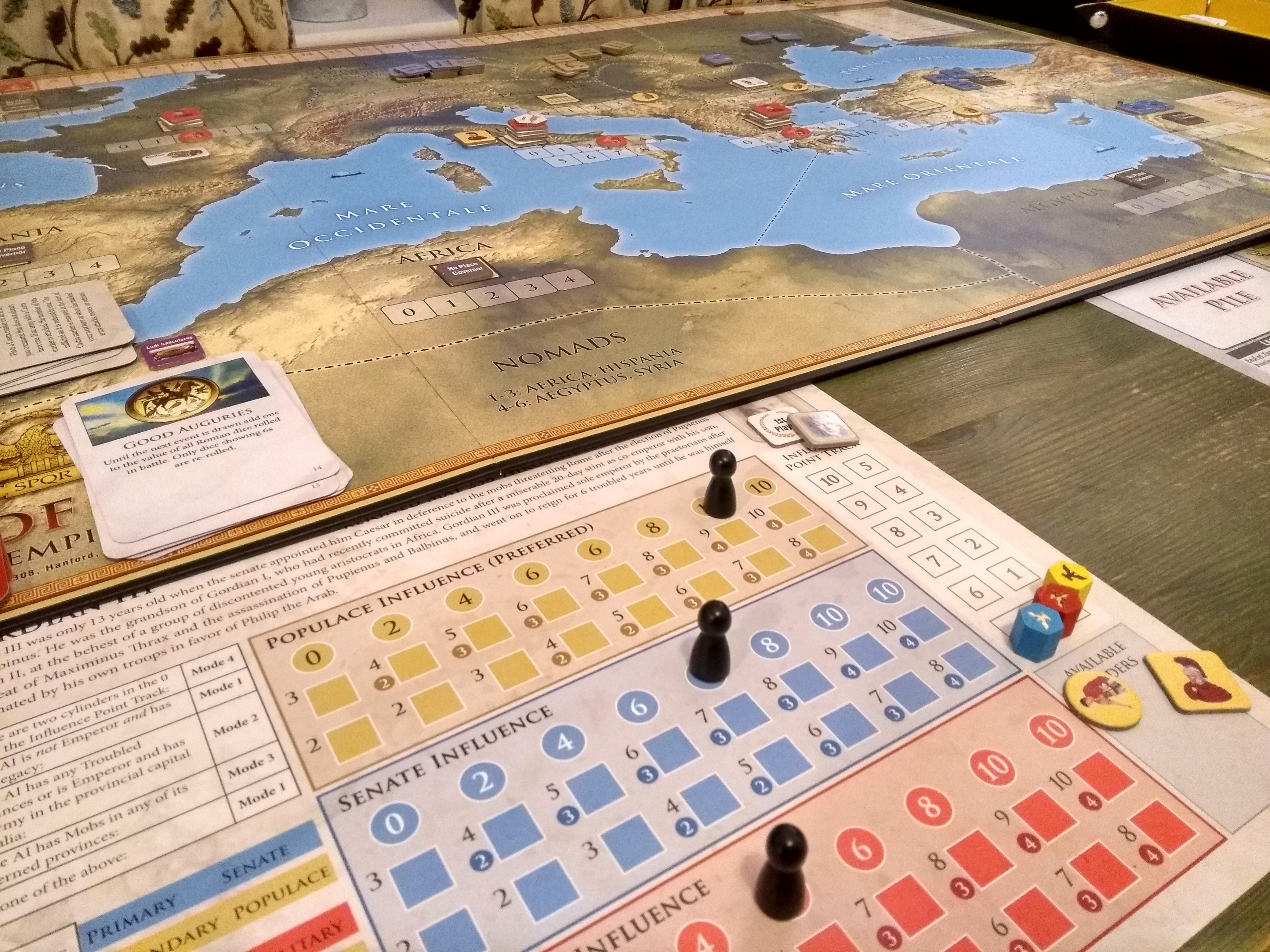
Time of Crisis
 |
| Actually not that much of a crisis. |
Shades of a classic
Marc Reichardt's recent article over on There Will Be Games, The Question of Consumption, hit a nerve for me, especially this sentence: "If it brings someone more joy to have Root and all its expansions sitting on a shelf in pristine condition, rather than actually on a table being used by them and their friends, hey, knock yourself out." This is me in fact – I do indeed have Root and all its expansions sitting on my shelf unused, with more to come via Kickstarter. However, this is not a situation that brings me joy, so I have made a start on actually learning and playing the expansions. Over the last few days I have played a couple of 3-way solo games with the aim of learning the Riverfolk company. In both games they came in a distant third against the Cats (who won both times) and the Alliance. The Riverfolk are very different, and playing them solo it is difficult to get a realistic sense of the trading that is central to their distinctive character. This week I plan to try them again against the Cat and Alliance bots, this time using the updates from the Better Bot Project which allow the bots to buy Riverfolk services.
 |
| This is what money looks like. |
Anyway, when I was playing the Riverfolk Company I got into the habit of placing warrior pieces on their board face down, to indicate that they are functioning as currency. And this reminded me of a similar situation in Civilization where the playing pieces have two faces – one represents potential population, and the other face represents currency which can be used to help buy civilization cards. But you have to be careful – if either face starts to dominate you can run into trouble. If you can't pay your taxes (2 population tokens per city converted into currency) you suffer a Revolt, or if you run out of population pieces then you can't expand on the map. This is reminiscent of the way the Riverfolk's economy works – too many of your own pieces in Funds restricts your presence on the map. But not enough Funds and you won't be able to take the actions you want to. I wonder if Cole Wehrle was thinking about Civilization when he designed the Riverfolk Company?
 |
| On the shoulders of giants? |
Tuesday, February 08, 2022
The past is another country
Blogger informs me that nimrods boasts 1,482 posts! Reading back over my past writings is a bit cringe-making, actually. Many of my attempts at jokiness come across as a bit silly. My comments on politics and current affairs seem naive or derivative, and don't really belong in a blog which is supposedly about board games (I feel especially ashamed when I look back at my comments on the so-called war on terror.) Likewise my occasional attempts at proselytising. Then even worse, there are occasional phrases which strike me now as unacceptably sexist. (Thankfully I haven't encountered anything racist or homophobic – yet!) As I come across such stuff I am feeling free to revise or excise as appropriate; I don't feel any obligation to preserve my words as originally written.
On the other hand, the short session reports scattered through the blog's early years are a really enjoyable trip down memory lane for me, recalling many long-forgotten happy times around the game table. May there be many more such times to come!
Monday, February 07, 2022
Blogging about board games since 2001
My very first entry on nimrods was posted on Thursday, April 19, 2001. Two posts actually – the first was a session report on a weekend-long play of Krieg! with my wargaming buddies Dave and Nick. We actually played it twice; I guess I had more stamina back then! The second post expressed worry that my games collection was overflowing the available shelf space, and shared a list of candidates for disposal. Some things never change – I recently posted a very similar entry on Instagram!
Nimrods was actually a very early entry into the board game blogging field. In fact I don't actually know of an earlier one. Mikko Saari started his excellent GameBlog in August 2002. Chris Farrell started blogging around that time, I'm not sure exactly when. So it's possible I was the first! However, unlike Mikko and Chris there has been a lengthy hiatus in my blogging career. My posting frequency slowed down a lot from 2007 onwards, and completely dried up by 2011. When I started blogging it was partly as a distraction from the boredom I was feeling with my career. However, in 2007 I made a new start, with a masters degree in neuroscience at King's College London followed by a PhD at University College London and a post-doc at Oxford. Neuroscience was pretty well all-consuming, and didn't leave much space for blogging. But I retired last year, and so have a little more free time and energy. So perhaps nimrods will come back to life. Let's see.
Wednesday, June 14, 2017
The wayward genius of Phil Eklund


As you can see, I'm a bit of a fan of Phil Eklund games. And this isn't even my whole collection. I've just said that a big part of their appeal for me is that his games are games of ideas. They give you something to think about. That doesn't mean that his ideas are necessarily very palatable. For example, Phil seems to be some sort of American libertarian. I'm all in favour of personal liberty, but the Ayn Rand style libertarianism that Phil seems to champion is more about liberty for corporations. The entrepreneurial spirit of capitalism operating in free markets is the great driver of human progress. At least that is what the rule booklet for Pax Renaissance tells me. My response to that is – tell that to the people in Bhopal. Pax Porfiriana, Phil's epic game of the Mexican revolution, teaches us that the world is divided into makers and takers, in other words taxation is simply extracting money with menaces. I prefer to think of taxation as a (very imperfect) common purse, to which we all contribute for the common good. Bios Megafauna, Phil's simply magnificent game about the last 250 million years of evolution, has a throwaway line in the rules about mankind's heroic efforts to avoid the next "snowball earth" by digging up and burning as much fossil fuel as possible. So much for the scientific consensus on climate change.
But I don't really mind all that. The great thing is that Phil Eklund reads widely and deeply, and builds his often heterodox conclusions into the structure of his truly excellent games. Giving me not only something great to play, but some truly interesting ideas to chew over and disagree with. Give me that over the latest idea-free Euro-deckbuilder any day.
Tuesday, May 02, 2017
A couple more thoughts on X-Wing fatigue

Star Wars: X-Wing in contrast went for a points-based build-your-own-squad approach. I can understand why, after all many people thoroughly enjoy the meta-game of squad building, the obsessive poring over lists which can fill the fan's leisure hours (and some of his working hours too!) But the price of this is a certain rock-paper-scissors flavour to one's encounters down at the local club. Your obsessed-over squad is quite likely to meet an opposing squad which simply steamrollers yours, with no possibility of playing skill or luck rescuing what is from the start a hopeless situation.

Stll, it would be nice to see FFG produce some proper balanced and playtested scenarios. I think it's unlikely, the current structure of the game with numerous upgrade packs marketed as single (or sometimes pairs of) ships, would make it difficult. The missions are a step in that direction, but you are still choosing your forces on points value, so the meta-game intrudes even here.
Sunday, April 16, 2017
X-Wing Fatigue
 I think I need a break from Star Wars: X-Wing.
I've been playing for about 15 months now, benefitting from the regular group that meets every Wednesday at Thirsty Meeples in Oxford. Great group of friendly guys ( and yes it is 95% guys), I've really enjoyed learning the game, building up my collection of rebel space ships (including 2 yes 2 Millenium Falcons!), reading the blogs, watching the matches on YouTube, listening to the podcasts, and even going to a few tournaments.
But... the last 3 weeks, taking a beating in every single game, from squads with such complicated shenanigans that I have no idea why you get to reroll that attack a third time! OK so I need to fly better and perhaps I'm not putting the hours into understanding this game and the multitude of upgrades and pilots available, but I dunno... I think I just need a break. Maybe only a short break, I'll probably be back with my tail wagging in a week or two. But for now, I think I want to think about something else. Maybe StarFarers of Catan.
Sunday, November 13, 2011

It was a partial success I would say. It took an awful long time - 6.5 to 7 hours I would guess altogether. I was the only one who had read the rules, so the first few hours I had to answer a LOT of rules questions for every turn. I felt like I was planning everyone's missions at one point! It's not that it's a complicated game - every one of us has mastered more complicated games - but it's unfamiliar, so not much in the way of conceptual landmarks.
Having said that - I loved it! Such a fascinating game, the time just flew by for me. I did very poorly, possibly because I was so busy answering rules questions that I didn't have time to think very clearly about what I was doing. Towards the end I did make some good progress claiming asteroids with a 4.1/3 thruster and a raygun, but too late to get back into the running.
Simon and Nick both seemed to enjoy it too, both expressing a willingness to play again. But Iain, having enjoyed the first few hours, seemed to lose the will to live a few times when he was trying to figure out how to organise his next mission. He won by a good margin (lots of glory points), but his final verdict on the game was "overwrought", "a prog-rock game"! So I don't anticipate persuading Iain to play it again any time soon.
So, this is a fantastic game, but not for everyone. And I'm sure it can be played a lot quicker than we managed by even slightly experienced players. A serious contender for my top 10 list.
Saturday, December 25, 2010
Christmas Civ
I'm spending Christmas with Sue's family in a luxury barn conversion buried in the snowy Herefordshire countryside. Even better, I've been playing Civilization with Sue's 12-year-old nephew Tom. We're using my old Gibson's edition, where the playing area for 2 players (Greece and Asia Minor) is helpfully colour-coded. The 2-player game is surprisingly challenging. Space is in short supply so Tom and I have been clashing for room regularly. We had an easy ride to start with, but then the calamities started coming thick and fast, and we are just emerging from a chaotic dark age of civil war, eruptions, epidemics and revolts. Love this game, still my number one.
Friday, December 17, 2010
Peaceniks at war
Another game of Struggle of Empires last night with the Mennonite boys. Just the three of us, and we were a little worried about the odd-man-out possibilities, but it seemed to work fine, and no-one felt their chances were closed down early in the game. Still, it doesn't matter how many times I play this game, I don't seem to be able to get the hang of how to win. One of my favourite tricks was much in evidence last night - buying a nice tile (such as Reserves) and then forgetting to use it at the critical moemnt. That re-roll could have spared me a lot of pain!
Darren was so inspired by the game that he resolved to buy it immediately, regardless of the OTT prices being achieved on eBay these days.
We finished with a round of Race for the Galaxy, where I managed to scrape a last-turn win against Sam's Spartan war-machine. Very satisfying.
Darren was so inspired by the game that he resolved to buy it immediately, regardless of the OTT prices being achieved on eBay these days.
We finished with a round of Race for the Galaxy, where I managed to scrape a last-turn win against Sam's Spartan war-machine. Very satisfying.
Thursday, December 09, 2010
Caucasus Campaign
I've been going quite slow on the game acquisition front - still money left in the 2010 budget - but I recently bought Caucasus Campaign (Mark Simonovitch, GMT) after reading very positive comments from Chris Farrell. Maybe I give too much weight to Chris's opinions sometimes, but I'm very pleased I followed his recommendation on this one.
I'm becoming a bit of a sucker for East Front panzer-pushers, accumulating a small stack of them on the shelf (Roads to Leningrad, Stalingrad Pocket, Von Manstein's Backhand Blow), but this one looks at first sight a little bit special. A beautiful map with large hexes, a small number of large attractive counters, 16 pages of clearly laid out rules printed in colour, and colourful and clear player-aids, all combine to make a very appealing first impression.
It's all laid out on the table awaiting my first solo play-through. Looking forward to it.
I'm becoming a bit of a sucker for East Front panzer-pushers, accumulating a small stack of them on the shelf (Roads to Leningrad, Stalingrad Pocket, Von Manstein's Backhand Blow), but this one looks at first sight a little bit special. A beautiful map with large hexes, a small number of large attractive counters, 16 pages of clearly laid out rules printed in colour, and colourful and clear player-aids, all combine to make a very appealing first impression.
It's all laid out on the table awaiting my first solo play-through. Looking forward to it.
Subscribe to:
Posts (Atom)